The AI Adoption Paradox: Why Waiting for Strategy (or Rushing Ahead) Is Holding You Back
by Sean Worthington | 23/02/2026Stop. Read This First.
If you know you need to do something more concrete about AI — and you’re midway through pulling your plans together — stop and read this.
Because when organisations wait for perfect strategic clarity before starting progressing their AI journey, they often fall straight into what I call AI strategy waterfall. Activity slows. Momentum disappears. Strategies are debated, refined, reinterpreted, turned into plans, cascaded through layers of the organisation — and by the time anything actually happens, the world has moved on.
AI is moving far too fast for that.
But here’s the catch.
Without any clear strategic direction, whatever AI activity is happening rarely hangs off a coherent structure. It becomes fragmented, localized, sub-optimised and risky.
Between Waterfall and the Wild West
Let’s compare it with something tangible. Before my beard was this colour (grey), every man and his dog was building Excel spreadsheets or Access databases to meet their niche purposes.. AI can feel disturbingly similar …like the Wild West.
The result can be wellintentioned people cobbling together solutions in distant corners of the organisation. Tools chosen for convenience, not coherence. Data moved around in insecurely. Except this time, those tools live on the internet, not just on someone’s desktop.
That’s the scary end of the spectrum.
More often, though, the opposite is true. Nothing dangerous is happening because almost nothing is happening at all. AI gets reduced to meeting summaries, drafted reports and jazzy slide decks. Useful? Yes. Differentiating? Not even close.
So organisations find themselves stuck between two enemies:
- AI strategy waterfall — where planning replaces progress
- Random AI adoption — where progress replaces control
Either way, momentum dies.
The Real Question
So how do you get going when these two forces are conspiring to immobilise you, your thinking and your organisation’s future?
How do you move fast without creating chaos? How do you create structure without killing momentum?
Starting From Both Ends
The mistake most organisations make is believing they must choose:
- Strategy first, execution later
- Or execution first, strategy later
That’s a false choice.
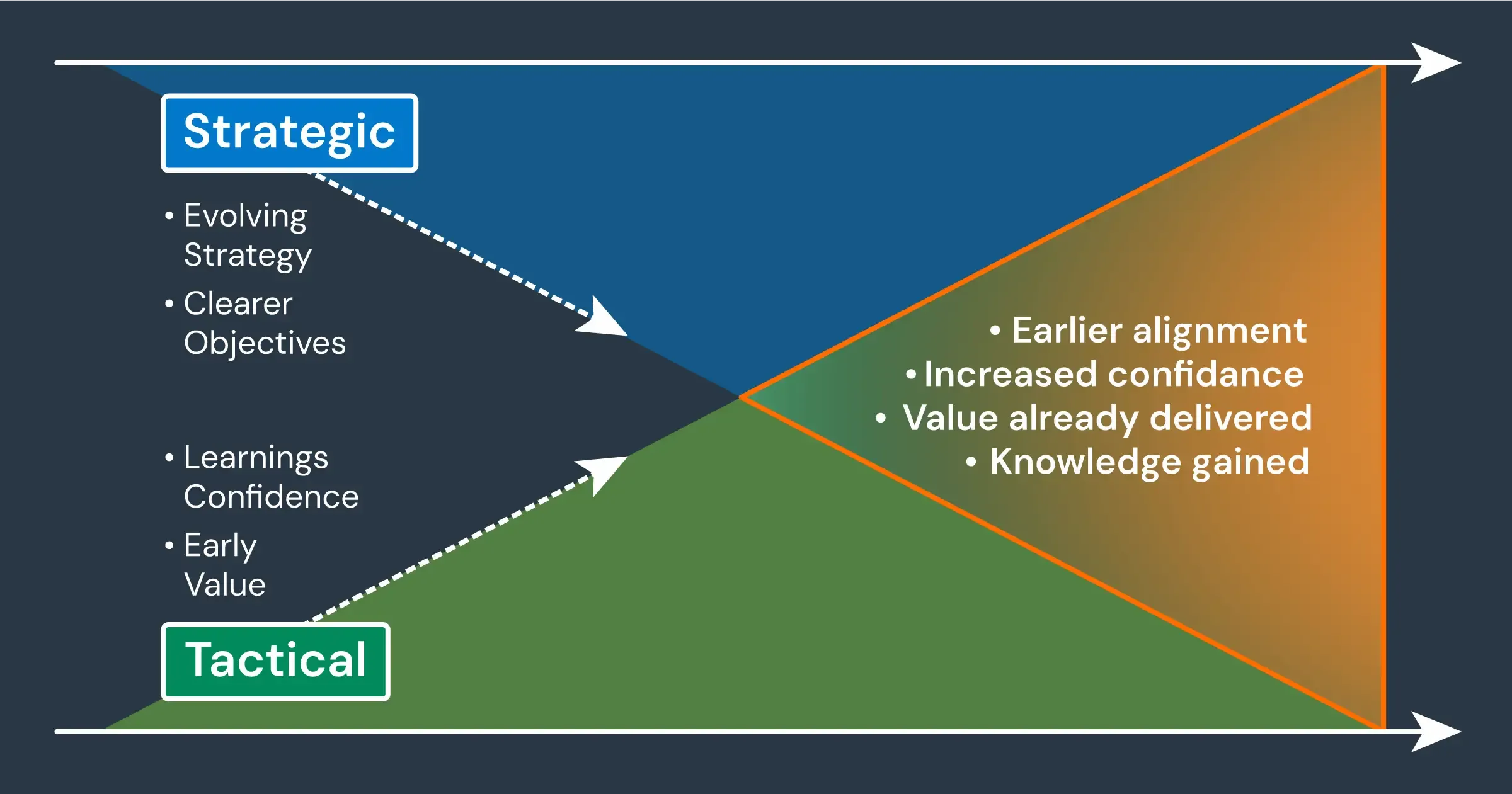
The reality is that you can — and should — start from both ends at once.
Working in parallel:
- You build early value, learning and confidence through small, controlled experiments
- While strategic clarity evolves based on evidence, not assumptions
This isn’t about throwing caution to the wind, overcommitting, or trying to become an overnight AI guru.
It’s about adopting a deliberately iterative and experimental approach — from both ends.
Standing on the Shoulders of Giants
This thinking isn’t new — but it is rarely combined.
Andrew Ng has long argued that organisations should start with quick wins, build confidence and create momentum before attempting grand AI transformations.
Itamar Gilad reminds us that at least 60% of good ideas will fail, so the only sensible approach is to test quickly, fail fast and learn faster.
Andy Grove gave us OKRs — a way to create alignment between strategy, objectives and measurable outcomes, and to adapt as reality unfolds.
Individually, these ideas are powerful.
Together, they point to something more interesting.
The Gap No One Talks About
Despite all the advice, frameworks and hype around AI, there is no widely adopted unified method for AI adoption inside organisations.
One that:
- Avoids strategy paralysis
- Avoids tactical chaos
- Builds confidence through evidence
- Delivers value early
- And evolves strategy as you learn
So we created one.
Introducing a New Way of Adopting AI
Over the last few years, working with organisations at very different stages of AI maturity, we’ve been refining a method that brings these ideas together.
A way of working that deliberately connects topdown strategic intent with bottomup experimental evidence.
A method designed to help organisations move faster, learn safely and deliver value continuously.
We’ll unpack that method — which we’ve come to call AdoptAI — over the next few posts.
What Comes Next
In this series, I’ll share:
- Why starting small works — and where it breaks down
- How experimentation creates strategic clarity rather than undermining it
- Why evidence beats opinion in AI decisionmaking
- And how AdoptAI ties strategy, experimentation and delivery together
- If your organisation wants (no… needs) — to adopt AI in a meaningful way, this series is for you.
In the next post, we’ll start by exploring why the advice to “start small” is right — but not enough on its own.
To make sure you don’t miss the next instalment, subscribe to our social channels — you’ll find the links in the footer of this site.
